Introduction
When developing Java applications, validating user input is a crucial task. This lab demonstrates three common methods to check if a given input is a valid integer:
- Using the
Integer.parseInt()method - Using the
Scanner.hasNextInt()method - Using the
Character.isDigit()method
We will implement each method step by step and understand their differences and use cases.
Setting Up the Java Project
Let's create a new Java file to implement our integer validation methods.
- Open your terminal and ensure you are in the
/home/labex/projectdirectory:
pwd
- Create a new Java file named
CheckInputInteger.java:
touch CheckInputInteger.java
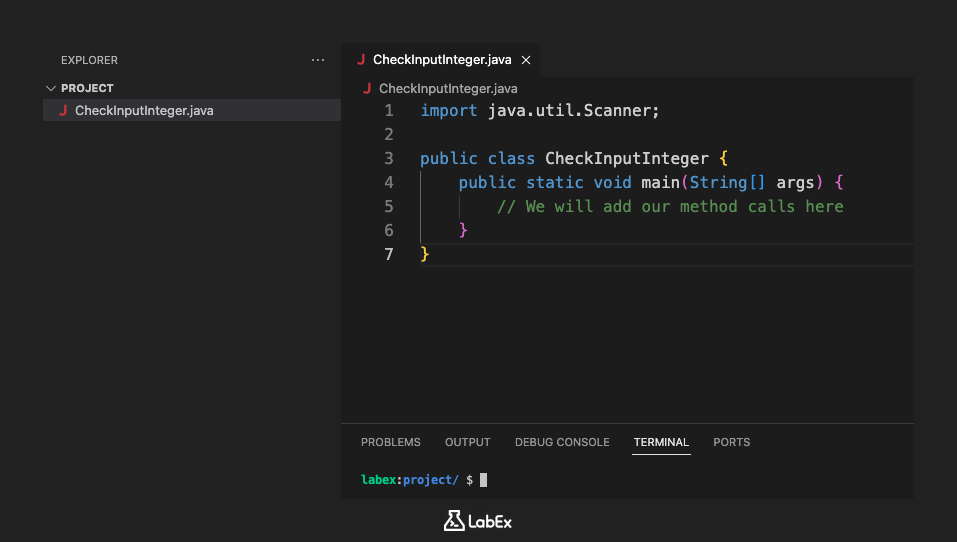
- Open the file in your preferred text editor and add the basic class structure:
import java.util.Scanner;

public class CheckInputInteger {
    public static void main(String[] args) {
        // We will add our method calls here
    }
}
Implementing Integer Validation Using Integer.parseInt()
The Integer.parseInt() method attempts to convert a string into an integer. If the conversion fails, it throws a NumberFormatException. We can use this behavior to validate integers.
- Add the following method to your
CheckInputInteger.javafile:
// Add this method inside the CheckInputInteger class
public static void checkUsingParseInt(String input) {
    try {
        // Attempt to parse the input string to an integer
        Integer.parseInt(input);
        System.out.println(input + " is a valid integer");
    } catch (NumberFormatException e) {
        // If parsing fails, the input is not a valid integer
        System.out.println(input + " is not a valid integer");
    }
}
- Update the
mainmethod to test this implementation:
// Modify the main method to test this implementation
public static void main(String[] args) {
    // Test cases
    checkUsingParseInt("123");    // Valid integer
    checkUsingParseInt("12.34");  // Not an integer
    checkUsingParseInt("abc");    // Not an integer
}
- The file should look like this:
import java.util.Scanner;

public class CheckInputInteger {
    // Define the method inside the class
    public static void checkUsingParseInt(String input) {
        try {
            // Attempt to parse the input string to an integer
            Integer.parseInt(input);
            System.out.println(input + " is a valid integer");
        } catch (NumberFormatException e) {
            // If parsing fails, the input is not a valid integer
            System.out.println(input + " is not a valid integer");
        }
    }

    public static void main(String[] args) {
        // Test cases
        checkUsingParseInt("123");    // Valid integer
        checkUsingParseInt("12.34");  // Not an integer
        checkUsingParseInt("abc");    // Not an integer
    }
}
- Compile and run your program:
javac CheckInputInteger.java
java CheckInputInteger
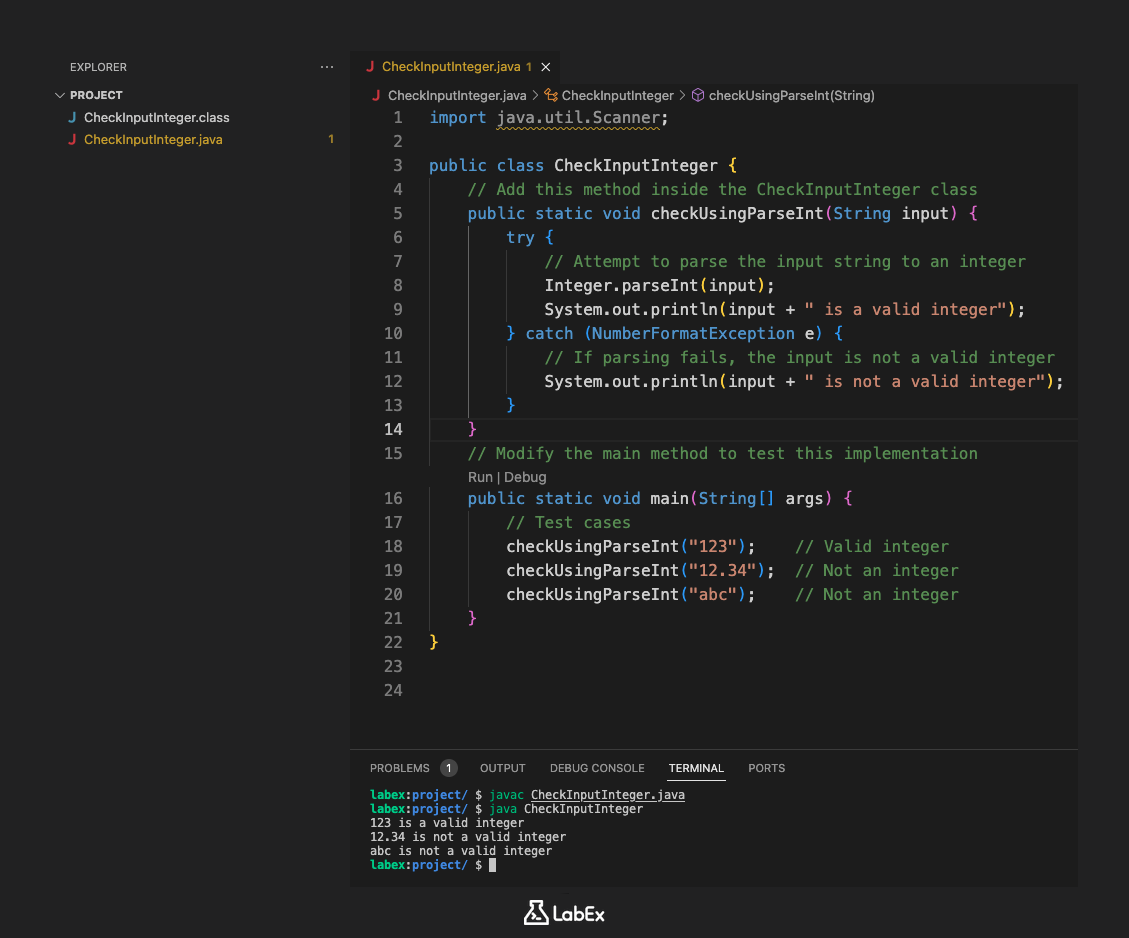
You should see the following output:
123 is a valid integer
12.34 is not a valid integer
abc is not a valid integer
Implementing Integer Validation Using Scanner.hasNextInt()
The Scanner class provides the hasNextInt() method to check if the next token in the input can be interpreted as an integer. This method is particularly useful when reading user input from the console.
- Add the following method to your
CheckInputInteger.javafile, inside theCheckInputIntegerclass:
public static void checkUsingScanner(String input) {
    Scanner scanner = new Scanner(input);
    if (scanner.hasNextInt()) {
        System.out.println(input + " is a valid integer");
    } else {
        System.out.println(input + " is not a valid integer");
    }
    scanner.close();
}
- Update the
mainmethod to include tests for this implementation:
public static void main(String[] args) {
    // Previous test cases
    checkUsingParseInt("123");
    checkUsingParseInt("12.34");
    checkUsingParseInt("abc");

    // New test cases
    checkUsingScanner("456");     // Valid integer
    checkUsingScanner("-789");    // Valid integer
    checkUsingScanner("12.34");   // Not an integer
}
- Compile and run your program:
javac CheckInputInteger.java
java CheckInputInteger
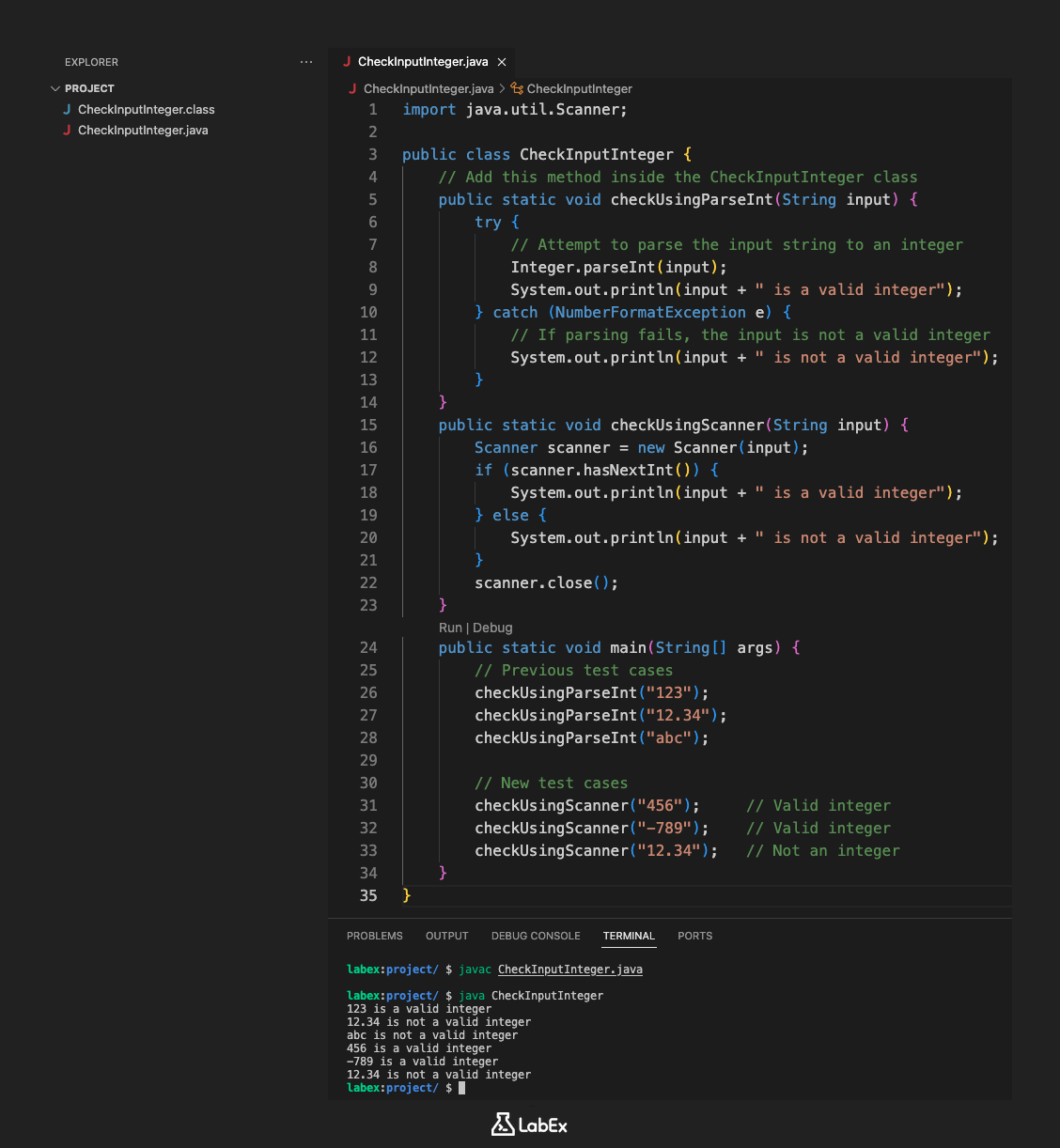
You should see the following output:
456 is a valid integer
-789 is a valid integer
12.34 is not a valid integer
This demonstrates that the Scanner.hasNextInt() method correctly identifies valid and invalid integers.
Implementing Integer Validation Using Character.isDigit()
The Character.isDigit() method checks if a character is a numeric digit. We can use this to validate integers by checking each character in the input string.
- Add the following method to your
CheckInputInteger.javafile:
public static void checkUsingIsDigit(String input) {
    boolean isValid = true;

    // Handle negative numbers by checking first character
    int startIndex = (input.charAt(0) == '-') ? 1 : 0;

    // Check each character
    for (int i = startIndex; i < input.length(); i++) {
        if (!Character.isDigit(input.charAt(i))) {
            isValid = false;
            break;
        }
    }

    if (isValid) {
        System.out.println(input + " is a valid integer");
    } else {
        System.out.println(input + " is not a valid integer");
    }
}
- Update the
mainmethod with the final test cases:
public static void main(String[] args) {
    // Previous test cases
    checkUsingParseInt("123");
    checkUsingParseInt("12.34");
    checkUsingParseInt("abc");

    checkUsingScanner("456");
    checkUsingScanner("-789");
    checkUsingScanner("12.34");

    // New test cases
    checkUsingIsDigit("789");     // Valid integer
    checkUsingIsDigit("-123");    // Valid integer
    checkUsingIsDigit("12.34");   // Not an integer
}
- Compile and run the final version of your program:
javac CheckInputInteger.java
java CheckInputInteger
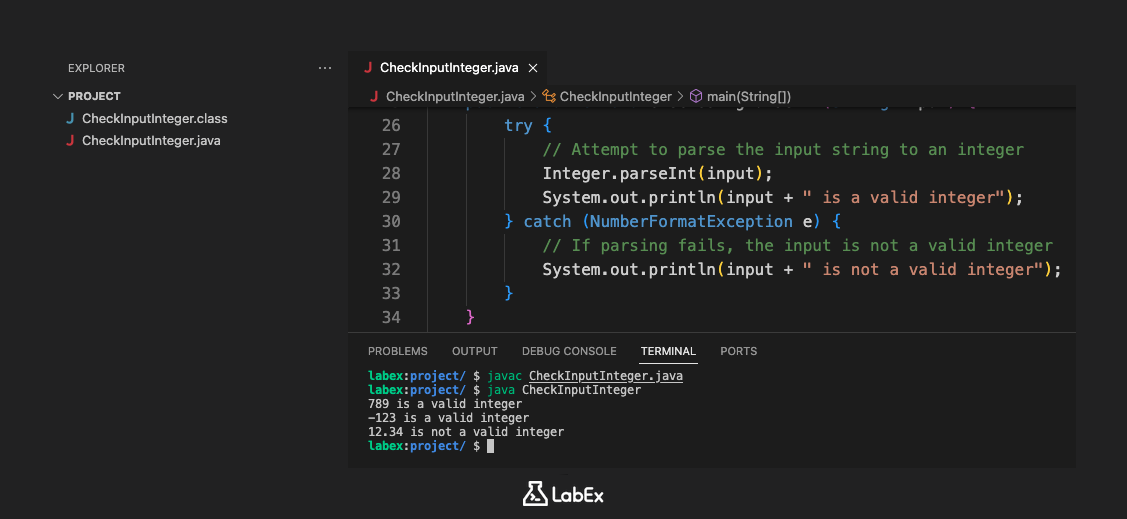
You should see the following output:
789 is a valid integer
-123 is a valid integer
12.34 is not a valid integer
Summary
In this lab, we explored three different methods to validate integer input in Java:
- The
Integer.parseInt()method, which is simple but requires exception handling - The
Scanner.hasNextInt()method, which is excellent for reading user input - The
Character.isDigit()method, which provides character-by-character validation
Each method has its advantages and use cases. The parseInt() method is good for simple string-to-integer conversion, Scanner.hasNextInt() is excellent for reading user input, and Character.isDigit() provides the most control over the validation process.
These validation techniques are essential for developing robust Java applications that can handle user input safely and effectively.