

Audit Your LXD API: Exposure, Client Trust, and Patch Evidence
Separate package state, network exposure, client identity, and authorization when reviewing a Linux management API after an LXD security update.

An HTTPS management endpoint answers. A client presents a valid certificate. The package manager says the software is current. Those are three observations, and none answers every question in a security review.
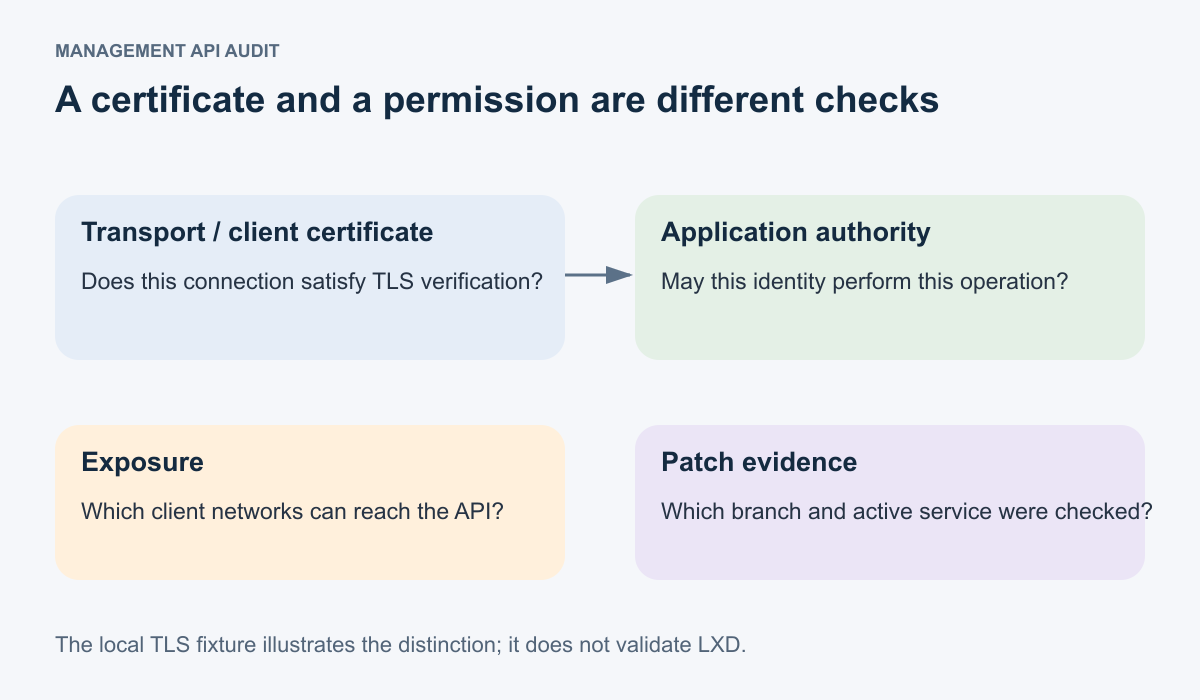
For a small LXD deployment, keep four pieces of evidence separate: the installed branch, the running service, who can reach its API, and which clients are trusted to do what.
Start with the branch you actually run
Canonical’s October 28 advisory describes a client-certificate authentication problem in LXD and MicroCloud. The maintainer’s advisory explains the certificate-chain boundary involved.
Use the current guidance for your installed channel. Do not combine version numbers from different release branches into a single “anything newer is safe” rule. The announcement and advisory list versions differently, and a package record alone does not establish which process is serving requests.
On a Snap-based LXD host, these are useful read-only starting points:
snap list lxd
snap info lxd
sudo snap services lxd
Record the channel, revision, version, and service state before taking the maintainer’s recommended update action. These commands are an inspection checklist, not a claim that this article patched or validated an LXD installation.
Check reachability from the right place
LXD’s network-exposure guide distinguishes local access from configuring network access. Read the documentation matching your release branch; latest may describe a newer version.
Inspect the local configuration and listeners:
lxc config get core.https_address
sudo ss -ltnp
A local listener is not an external reachability test. A host firewall, upstream firewall, proxy, and network path can change which clients reach it. Check from an authorized client location relevant to your deployment, not from an arbitrary public scanner.
Then inspect the configured trust relationships:
lxc config trust listKeep certificate fingerprints and identities in your private audit record. Do not paste trust lists, keys, or account details into a public issue merely to ask whether the endpoint is secure.
A valid identity can still receive a rejection
A separate local experiment makes the next boundary concrete. We created a temporary certificate authority, a server certificate, and two client certificates. Both clients passed the Python TLS server’s certificate verification. The tiny application allowed only one synthetic identity:
| Client | Certificate accepted | Application response |
|---|---|---|
reader |
Yes | HTTP 200 |
visitor |
Yes | HTTP 403 |
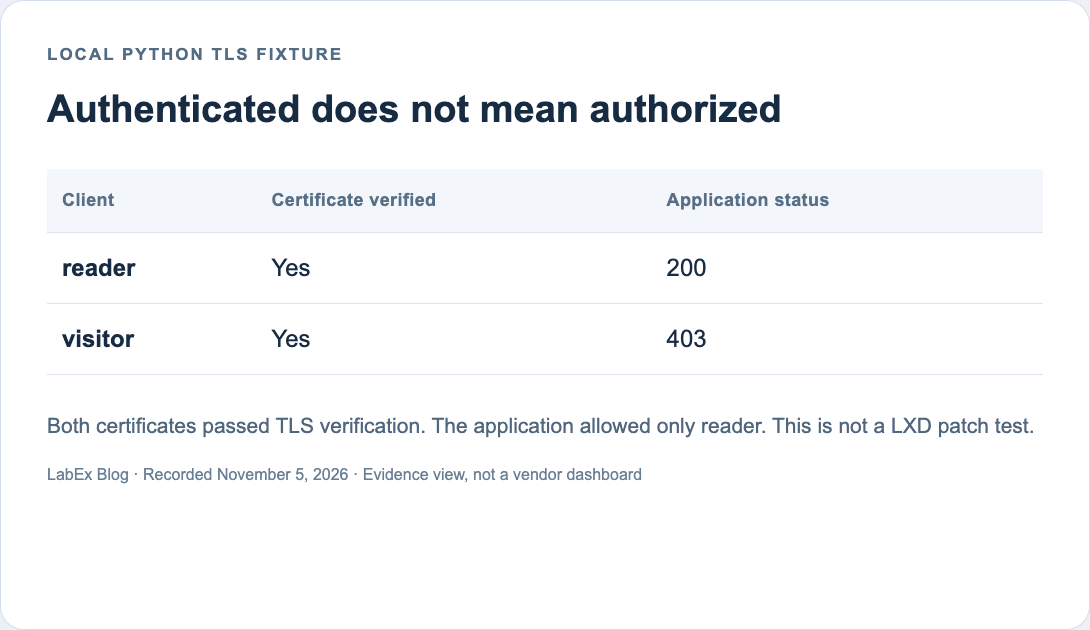
Local Python TLS fixture, tested November 5, 2026. This illustrates authentication versus authorization; it is not an LXD exploit or patch test.
The experiment is deliberately small. A certificate chain accepted by a TLS configuration and a permission decision made by an application are different pieces of evidence. Neither an HTTP success nor a rejection should be interpreted without knowing which layer produced it.
For certificate prerequisites, Generate X.509 Certificates on LabEx is a relevant activity. It does not reproduce the LXD vulnerability.
Save a result another person can review
A useful audit note is short enough to keep current:
- Software: branch, channel, revision, running service, and the advisory checked.
- Exposure: intended listener, permitted client networks, and the actual test location.
- Identity: trusted client records and their intended owners.
- Authority: operations a normal client may perform and should be denied.
- Evidence: commands, observations, time, and unresolved questions.
After an update, repeat the checks that establish the intended state. Avoid concluding “no compromise” from a new version or a single clean request. The record should say exactly what was observed, so the next maintainer can distinguish a verified result from an assumption.
References
- Canonical security advisory: affected products and channel-specific update guidance.
- Maintainer’s certificate-chain advisory: the reported authentication boundary.
- Expose LXD to the network: network configuration model.
- Python SSL documentation: certificate verification used in the illustrative fixture. Sources checked November 5, 2026.