

What Does an EU-Restricted Cloudflare Workflow Actually Keep in the EU?
Map Workflow execution, persisted state, settings, ingress, and external calls before treating a jurisdiction setting as an application-wide data boundary.

You set jurisdiction to eu, then a Workflow calls an external API. Has the whole application’s data stayed inside the EU?
The setting alone cannot answer that. Start by listing the data paths, then match each one to the product guarantee that actually covers it.
Locate the promise before drawing the boundary
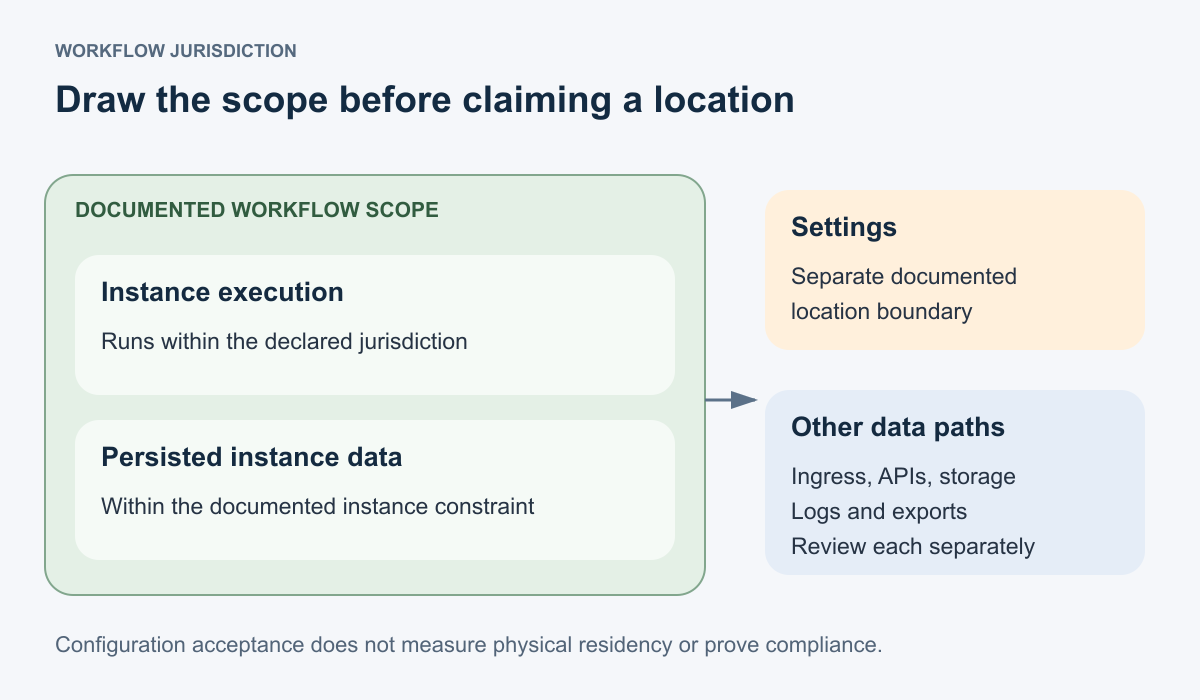
Cloudflare added Workflows jurisdictions on October 27, 2026. The data-location reference says the constraint covers where Workflow instances run and persist data. It separately notes that Workflow settings are stored outside the specified jurisdiction, and that Workers can create and manage instances from elsewhere.
Those distinctions are the article’s starting point. A guarantee about Workflow instances is not a guarantee about every service the application uses.
EU and UK are also different labels. Do not interpret an eu option as a country-specific placement choice or silently treat it as a UK restriction.
Give each data path its own row
Take a synthetic document-review app. Its request contains a reference, its Workflow records a result, and a later step might contact another service.
| Path | What to record | What the Workflow setting tells you |
|---|---|---|
| Incoming request | Entry service and processing path | It does not describe the entire ingress path |
| Workflow execution | The declared jurisdiction | The documented instance constraint applies |
| Persisted Workflow data | What inputs and results are retained | The documented instance constraint applies |
| Workflow settings | Configuration and control information | The reference states a separate location boundary |
| External API or storage | Destination and transmitted fields | Check that service’s own behavior and configuration |
| Logs and exports | Content, destination, and retention | Inspect the relevant observability path separately |
The last row is an inventory requirement, not a claim that a particular logging product stores data in a particular place. An empty cell means the architecture review is unfinished.
This is a technical scope check. It does not determine whether an application meets a legal obligation.
Validate a minimal configuration
Here is the shape of the local fixture we checked:
{
  "name": "blog-jurisdiction-fixture",
  "main": "index.js",
  "compatibility_date": "2026-11-05",
  "workflows": [
    {
      "name": "blog-eu-fixture",
      "binding": "REVIEW",
      "class_name": "EvidenceWorkflow",
      "jurisdiction": "eu"
    }
  ]
}
Its EvidenceWorkflow class extends WorkflowEntrypoint and returns a synthetic review result through a step. The fixture contains no personal information and makes no external API call.
Using Wrangler 4.157.0, a local build accepted the configuration and reported the REVIEW Workflow binding:
npx wrangler@4.157.0 deploy --dry-run --outdir /tmp/workflow-build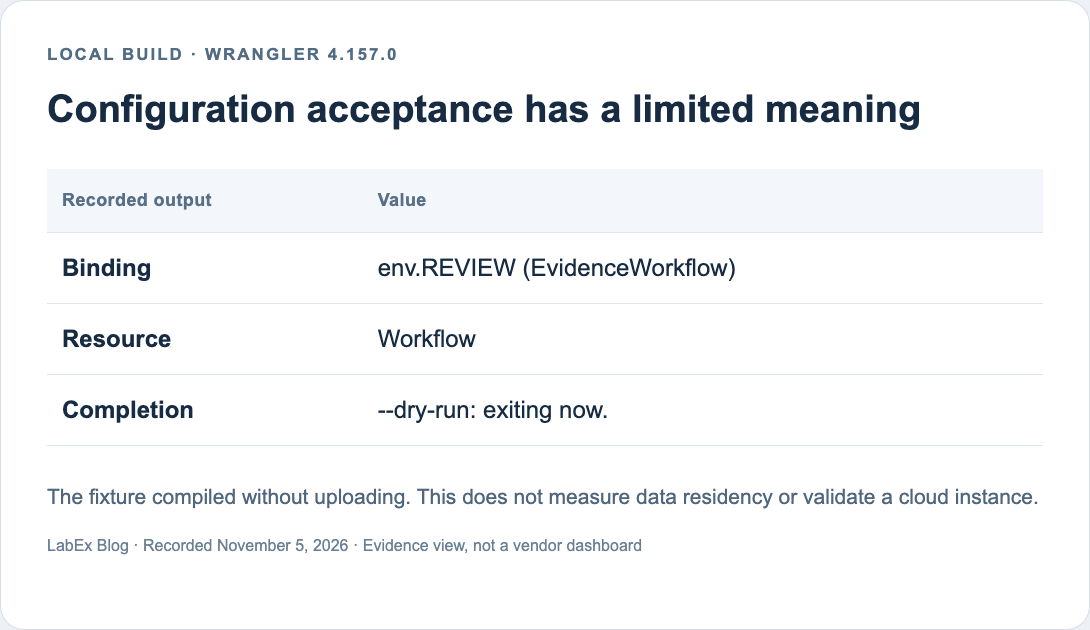
Local build evidence from November 5, 2026. No cloud Workflow or instance was created.
The command name includes deploy, but --dry-run stops before upload. The result establishes that this tool version accepts and builds the fixture. It does not measure a physical data location, test a remote instance, or verify the rest of the app’s data paths.
The exact fixture is available as downloadable example files. Unzip it into a disposable directory before running the command.
A deployment decision can be harder to undo than a field edit
The official reference makes jurisdiction a creation-time choice and describes a mismatch with an existing Workflow as a deployment error. Check current Wrangler requirements and migration options before changing a real service. Local acceptance cannot prove what a remote deployment will do with an existing resource.
For a learning project, make the decision while the resource is disposable. Record why the selected jurisdiction fits the intended task and which adjacent paths remain outside that choice.
The LabEx Cloudflare path provides background in Worker configuration, state, and service boundaries. It is not presented here as a verified Workflows-jurisdiction lab.
Keep the data-path table next to the configuration review. When a new storage service, external API, or telemetry export is added, add its row before claiming that the old boundary still describes the application.
References
- Workflows jurisdiction announcement: the new configuration option.
- Workflows data location: scope, settings, and creation-time constraints.
- Build your first Workflow: entry-point and binding model. Sources checked November 5, 2026.