Introdução
Como programador Python, você pode encontrar o erro "ValueError: too many values to unpack", que pode ser bastante frustrante. Neste tutorial, você entenderá esse erro, identificará sua causa raiz e aprenderá soluções práticas para resolvê-lo. Ao final deste laboratório, você estará preparado para lidar com segurança com esse problema comum do Python.
Entendendo o ValueError: Too Many Values to Unpack
Nesta etapa, você reproduzirá erros de desempacotamento e distinguirá uma incompatibilidade na quantidade de valores do desempacotamento de um objeto não iterável.
O erro ValueError: too many values to unpack ocorre com frequência no Python quando você tenta atribuir vários valores a uma variável ou a um conjunto de variáveis, mas a quantidade de variáveis não corresponde à quantidade de valores. Esse erro geralmente acontece quando a quantidade de variáveis no lado esquerdo de uma instrução de atribuição não corresponde à quantidade de valores no lado direito.
O que é desempacotamento no Python?
Desempacotamento no Python é o processo de atribuir elementos individuais de um iterável, como uma lista, tupla ou string, a várias variáveis em uma única instrução de atribuição. Por exemplo:
x, y, z = [1, 2, 3]
Nesse caso, os valores 1, 2 e 3 são desempacotados e atribuídos às variáveis x, y e z, respectivamente.
Causas do ValueError: too many values to unpack
O erro ValueError: too many values to unpack pode ocorrer nos seguintes casos:
Quantidade diferente de variáveis e valores: quando a quantidade de variáveis no lado esquerdo de uma instrução de atribuição não corresponde à quantidade de valores no lado direito.
x, y = [1, 2, 3] ## This will cause a ValueErrorDesempacotamento de um objeto não iterável: este é um erro de desempacotamento relacionado, mas o Python gera um
TypeError, e não umValueError. Por exemplo, um número inteiro não pode ser desempacotado porque não é iterável.x, y = 42 ## This will cause a TypeErrorDesempacotamento de um gerador ou iterador com mais elementos do que variáveis: quando você tenta desempacotar um gerador ou iterador que contém mais elementos do que a quantidade de variáveis.
x, y = (i for i in range(5)) ## This will cause a ValueError
Vamos criar um arquivo Python para observar esse erro na prática.
Abra o terminal do WebIDE e navegue até o diretório do projeto, caso ainda não esteja nele:
cd ~/project
Agora, crie um novo arquivo Python chamado unpack_error.py usando o editor do WebIDE.
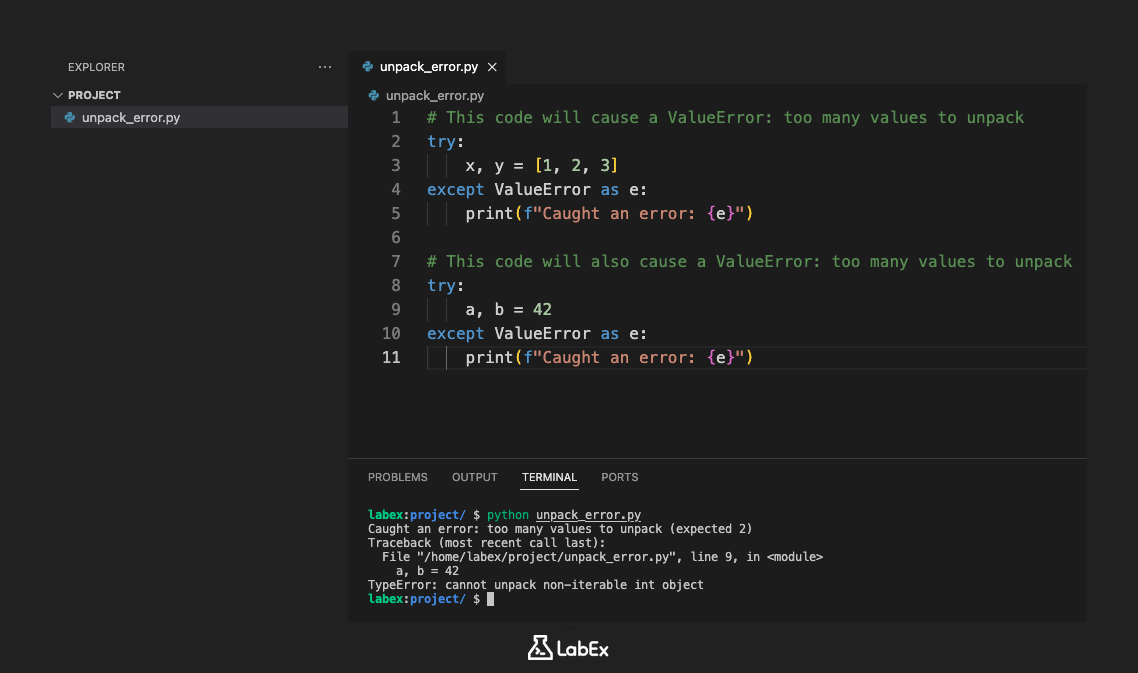
No arquivo unpack_error.py, adicione o código a seguir:
## This code will cause a ValueError: too many values to unpack
try:
    x, y = [1, 2, 3]
except ValueError as e:
    print(f"Caught an error: {e}")

## This code will cause a TypeError because an integer is not iterable
try:
    a, b = 42
except TypeError as e:
    print(f"Caught an error: {e}")
Salve o arquivo.
Agora, execute o script Python no terminal:
python unpack_error.py
Você deverá ver uma saída semelhante à seguinte, mostrando o ValueError:
Caught an error: too many values to unpack (expected 2)
Caught an error: cannot unpack non-iterable int object
Isso demonstra duas falhas diferentes de desempacotamento. O Python gera ValueError quando um iterável fornece mais valores do que as variáveis conseguem receber, e gera TypeError quando o objeto não é iterável.
Identificando e diagnosticando o erro
Nesta etapa, você diagnosticará cada falha de desempacotamento examinando a atribuição e o objeto no lado direito.
Quando encontrar o erro ValueError: too many values to unpack, a própria mensagem de erro fornecerá informações importantes. Normalmente, ela informa a quantidade esperada de valores e a quantidade de valores recebida.
Por exemplo, a mensagem de erro ValueError: too many values to unpack (expected 2) indica que o código esperava desempacotar 2 variáveis, mas recebeu mais de 2 valores.
Para diagnosticar o erro ValueError: too many values to unpack, siga estas etapas:
- Identifique a linha do código: o traceback apontará para a linha específica em que o erro ocorreu.
- Examine a instrução de atribuição: observe a instrução de atribuição nessa linha. Identifique as variáveis no lado esquerdo e a expressão no lado direito.
- Determine a quantidade de variáveis: conte a quantidade de variáveis no lado esquerdo da atribuição.
- Inspecione o lado direito: determine se o objeto é iterável. Um objeto não iterável causa
TypeError; um iterável pode causarValueErrorquando fornece uma quantidade incorreta de valores. - Compare as quantidades: para um iterável, compare a quantidade de variáveis com a quantidade de valores fornecidos.
Vamos modificar o arquivo unpack_error.py para adicionar comentários que expliquem os valores esperados e os valores recebidos.
Abra unpack_error.py no editor do WebIDE.
Modifique o código para incluir comentários como estes:
## This code will cause a ValueError: too many values to unpack
## Expected variables: 2 (x, y)
## Actual values from [1, 2, 3]: 3
try:
    x, y = [1, 2, 3]
except ValueError as e:
    print(f"Caught an error: {e}")

## This code will cause a TypeError because an integer is not iterable
## Expected variables: 2 (a, b)
## The integer 42 supplies no iterable values
try:
    a, b = 42
except TypeError as e:
    print(f"Caught an error: {e}")

## Example of unpacking a generator with too many values
## Expected variables: 2 (c, d)
## Actual values from (i for i in range(5)): 5
try:
    c, d = (i for i in range(5))
except ValueError as e:
    print(f"Caught an error: {e}")
Salve o arquivo.
Execute o script novamente:
python unpack_error.py
A saída será semelhante, mas agora o código conterá comentários que ajudam a explicar por que o erro ocorre, informando explicitamente as quantidades esperada e recebida.
Caught an error: too many values to unpack (expected 2)
Caught an error: cannot unpack non-iterable int object
Caught an error: too many values to unpack (expected 2)
Ao verificar primeiro se o lado direito é iterável e depois comparar a quantidade de valores com a quantidade de variáveis, você consegue distinguir TypeError de ValueError: too many values to unpack.
Resolvendo o ValueError: soluções práticas
Nesta etapa, você resolverá o ValueError fazendo a quantidade de variáveis corresponder à quantidade de valores do iterável.
Agora que você entende as causas e o diagnóstico do ValueError: too many values to unpack, vamos conhecer algumas soluções práticas para resolver esse problema.
Solução 1: ajustar a quantidade de variáveis
A solução mais simples é ajustar a quantidade de variáveis no lado esquerdo da instrução de atribuição para que corresponda à quantidade de valores no lado direito.
Vamos criar um novo arquivo Python chamado unpack_solution1.py no diretório ~/project usando o editor do WebIDE.
Adicione o código a seguir ao arquivo unpack_solution1.py:
## Example 1: Adjusting variables to match a list
data1 = [10, 20, 30]
## We have 3 values, so we need 3 variables
x, y, z = data1
print(f"Example 1: x={x}, y={y}, z={z}")

## Example 2: Adjusting variables to match a tuple
data2 = ('apple', 'banana')
## We have 2 values, so we need 2 variables
fruit1, fruit2 = data2
print(f"Example 2: fruit1={fruit1}, fruit2={fruit2}")

## Example 3: Adjusting variables to match a string (unpacking characters)
data3 = "hi"
## We have 2 characters, so we need 2 variables
char1, char2 = data3
print(f"Example 3: char1={char1}, char2={char2}")
Salve o arquivo.
Execute o script no terminal:
python unpack_solution1.py
Você deverá ver a seguinte saída:
Example 1: x=10, y=20, z=30
Example 2: fruit1=apple, fruit2=banana
Example 3: char1=h, char2=i
Nesses exemplos, garantimos que a quantidade de variáveis no lado esquerdo correspondesse exatamente à quantidade de elementos do iterável no lado direito. Assim, evitamos o ValueError.
Resolvendo o ValueError: usando o operador asterisco
Nesta etapa, você usará o operador asterisco (*) para coletar os valores extras do iterável em uma lista.
Às vezes, você pode querer desempacotar os primeiros elementos de um iterável e reunir o restante em uma única lista. O operador asterisco (*), também chamado de operador “star” ou operador de desempacotamento, é ideal para isso. Ele permite atribuir os elementos restantes de um iterável a uma única variável como uma lista.
Vamos criar um novo arquivo Python chamado unpack_solution2.py no diretório ~/project usando o editor do WebIDE.
Adicione o código a seguir ao arquivo unpack_solution2.py:
## Example 1: Unpacking the first element and collecting the rest
data1 = [10, 20, 30, 40, 50]
## Assign the first element to 'first' and the rest to 'rest_of_data'
first, *rest_of_data = data1
print(f"Example 1: first={first}, rest_of_data={rest_of_data}")

## Example 2: Unpacking the first two elements and collecting the rest
data2 = ('a', 'b', 'c', 'd')
## Assign the first two elements to 'item1' and 'item2', and the rest to 'remaining_items'
item1, item2, *remaining_items = data2
print(f"Example 2: item1={item1}, item2={item2}, remaining_items={remaining_items}")

## Example 3: Unpacking the last element and collecting the rest
data3 = [1, 2, 3, 4, 5]
## Assign the last element to 'last' and the rest to 'all_but_last'
*all_but_last, last = data3
print(f"Example 3: all_but_last={all_but_last}, last={last}")

## Example 4: Unpacking the first and last elements and collecting the middle
data4 = "python"
## Assign the first char to 'start', the last to 'end', and the middle to 'middle'
start, *middle, end = data4
print(f"Example 4: start={start}, middle={middle}, end={end}")
Salve o arquivo.
Execute o script no terminal:
python unpack_solution2.py
Você deverá ver a seguinte saída:
Example 1: first=10, rest_of_data=[20, 30, 40, 50]
Example 2: item1=a, item2=b, remaining_items=['c', 'd']
Example 3: all_but_last=[1, 2, 3, 4], last=5
Example 4: start=p, middle=['y', 't', 'h', 'o'], end=n
O operador asterisco oferece uma maneira flexível de lidar com o desempacotamento quando a quantidade de elementos do iterável pode ser maior que a quantidade de variáveis nomeadas explicitamente. A variável precedida por * sempre receberá uma lista com os itens restantes, que pode ser uma lista vazia caso não haja itens restantes.
Resolvendo o ValueError: usando indexação ou fatiamento
Nesta etapa, você usará indexação e fatiamento para selecionar valores sem desempacotar todo o iterável.
Se você precisar apenas de elementos específicos de um iterável e não quiser desempacotá-lo por completo, poderá usar indexação ou fatiamento para acessar os elementos desejados. Isso evita o erro de desempacotamento porque você não tenta atribuir vários valores a uma quantidade fixa de variáveis em uma única atribuição.
Vamos criar um novo arquivo Python chamado unpack_solution3.py no diretório ~/project usando o editor do WebIDE.
Adicione o código a seguir ao arquivo unpack_solution3.py:
## Example 1: Using indexing to get specific elements
data1 = [100, 200, 300, 400]
## Get the first and third elements using indexing
first_element = data1[0]
third_element = data1[2]
print(f"Example 1: first_element={first_element}, third_element={third_element}")

## Example 2: Using slicing to get a subset of elements
data2 = ('a', 'b', 'c', 'd', 'e')
## Get elements from index 1 up to (but not including) index 4
subset_of_data = data2[1:4]
print(f"Example 2: subset_of_data={subset_of_data}")

## Example 3: Using indexing with a string
data3 = "hello"
## Get the second character
second_char = data3[1]
print(f"Example 3: second_char={second_char}")
Salve o arquivo.
Execute o script no terminal:
python unpack_solution3.py
Você deverá ver a seguinte saída:
Example 1: first_element=100, third_element=300
Example 2: subset_of_data=('b', 'c', 'd')
Example 3: second_char=e
Usar indexação ([]) e fatiamento ([:]) permite acessar elementos individuais ou subconjuntos de elementos de um iterável sem precisar fazer a quantidade de variáveis corresponder à quantidade total de elementos. Essa é uma maneira comum e segura de trabalhar com iteráveis quando você não precisa desempacotar tudo.
Resumo
Neste tutorial abrangente de Python, exploramos o erro "ValueError: too many values to unpack". Você aprendeu que esse erro ocorre quando a quantidade de variáveis no lado esquerdo de uma atribuição não corresponde à quantidade de itens do iterável no lado direito.
Você praticou:
- Identificar o erro e entender sua causa.
- Diagnosticar o erro comparando a quantidade de variáveis e valores.
- Resolver o erro ajustando a quantidade de variáveis.
- Usar o operador asterisco (
*) para fazer desempacotamento flexível. - Usar indexação e fatiamento para acessar elementos específicos sem fazer o desempacotamento completo.
Ao entender os princípios subjacentes e aplicar as técnicas práticas apresentadas, você estará preparado para lidar com esse erro comum e aprimorar suas habilidades de programação em Python. Dominar o tratamento de erros é um aspecto essencial para se tornar um desenvolvedor Python proficiente.