Introdução
Ao trabalhar com dados textuais em Python, frequentemente é necessário comparar strings para determinar se elas contêm a mesma informação, independentemente de as letras serem maiúsculas ou minúsculas. Isso é chamado de comparação de strings case-insensitive (que não diferencia maiúsculas de minúsculas).
Neste laboratório, você aprenderá diferentes métodos para comparar duas strings Python quanto à igualdade, ignorando as diferenças de caixa. Você explorará a comparação básica de strings, várias técnicas para comparação case-insensitive, e verá como aplicar essas habilidades em cenários do mundo real.
Ao final deste laboratório, você será capaz de implementar com confiança comparações de strings case-insensitive em seus programas Python, aprimorando sua capacidade de lidar com dados textuais de forma eficaz.
Compreendendo a Comparação de Strings em Python
Vamos começar explorando como as comparações de strings funcionam em Python e por que a sensibilidade a maiúsculas e minúsculas é importante.
Comparação de Strings Padrão
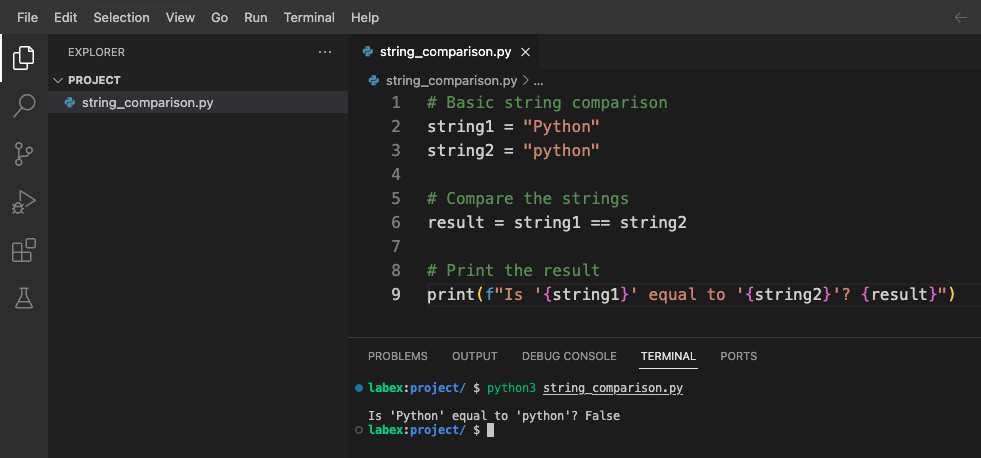
Em Python, quando você compara duas strings usando o operador de igualdade (==), a comparação é case-sensitive (sensível a maiúsculas e minúsculas) por padrão. Isso significa que "Hello" e "hello" são consideradas strings diferentes.
Vamos criar um novo arquivo Python para testar isso:
- No WebIDE, clique no ícone "Explorer" na barra lateral esquerda.
- Clique no botão "New File" e nomeie-o como
string_comparison.py. - Adicione o seguinte código ao arquivo:
## Basic string comparison
string1 = "Python"
string2 = "python"

## Compare the strings
result = string1 == string2

## Print the result
print(f"Is '{string1}' equal to '{string2}'? {result}")
- Salve o arquivo pressionando
Ctrl+Sou selecionando "File" > "Save" no menu. - Execute o script abrindo um terminal (Terminal > New Terminal) e digitando:
python3 string_comparison.py
Você deve ver a seguinte saída:
Is 'Python' equal to 'python'? False
A saída mostra False porque a comparação é case-sensitive, e "Python" com um 'P' maiúsculo não é o mesmo que "python" com um 'p' minúsculo.
Por que a Comparação Case-Insensitive é Útil
A comparação case-insensitive é útil em muitos cenários:
- Validação da entrada do usuário (os usuários podem digitar em qualquer caixa)
- Pesquisa de texto (pesquisando palavras independentemente da caixa)
- Processamento de linguagem natural (onde a capitalização pode variar)
- Trabalhando com URLs, endereços de e-mail ou nomes de usuário (que podem ser case-insensitive)
Vamos modificar nosso script para adicionar alguns exemplos que demonstrem quando a comparação case-insensitive é útil:
## Add these examples to string_comparison.py

## Example: User searching for content
user_search = "Python"
article_title = "Getting Started with python Programming"

## Case-sensitive comparison (might miss relevant content)
found_sensitive = user_search in article_title
print(f"Case-sensitive search found match: {found_sensitive}")

## What if we want to find matches regardless of case?
## We'll explore solutions in the next steps
Adicione este código ao seu arquivo string_comparison.py e execute-o novamente:
python3 string_comparison.py
A saída agora inclui:
Case-sensitive search found match: False
Isso mostra um problema prático: um usuário que pesquisa por "Python" não encontraria conteúdo intitulado "python Programming" com a comparação case-sensitive padrão.
No próximo passo, aprenderemos como realizar comparações case-insensitive para resolver este problema.
Métodos de Comparação de Strings Case-Insensitive
Agora que você entende por que a comparação case-insensitive é importante, vamos aprender diferentes métodos para realizá-la em Python.
Método 1: Usando lower() ou upper()
A abordagem mais comum é converter ambas as strings para a mesma caixa antes de compará-las. Você pode usar os métodos lower() ou upper() para esse fim.
Vamos criar um novo arquivo para testar esses métodos:
- No WebIDE, crie um novo arquivo e nomeie-o como
case_insensitive.py. - Adicione o seguinte código:
## Case-insensitive comparison using lower()
string1 = "Python"
string2 = "python"

## Convert both strings to lowercase, then compare
result_lower = string1.lower() == string2.lower()
print(f"Using lower(): '{string1}' equals '{string2}'? {result_lower}")

## Convert both strings to uppercase, then compare
result_upper = string1.upper() == string2.upper()
print(f"Using upper(): '{string1}' equals '{string2}'? {result_upper}")
- Salve o arquivo e execute-o com:
python3 case_insensitive.py
Você deve ver:
Using lower(): 'Python' equals 'python'? True
Using upper(): 'Python' equals 'python'? True
Ambos os métodos produzem o mesmo resultado - eles confirmam que as strings são iguais quando a caixa é ignorada.
Método 2: Usando casefold()
O método casefold() é semelhante a lower(), mas fornece uma case folding (dobramento de caixa) mais agressiva que funciona melhor para certos idiomas com regras especiais de mapeamento de caixa.
Adicione o seguinte código ao seu arquivo case_insensitive.py:
## Case-insensitive comparison using casefold()
german_string1 = "Straße"  ## German word for "street"
german_string2 = "STRASSE" ## Uppercase version (note: ß becomes SS when uppercased)

## Using lower()
result_german_lower = german_string1.lower() == german_string2.lower()
print(f"Using lower() with '{german_string1}' and '{german_string2}': {result_german_lower}")

## Using casefold()
result_german_casefold = german_string1.casefold() == german_string2.casefold()
print(f"Using casefold() with '{german_string1}' and '{german_string2}': {result_german_casefold}")
Execute o script novamente:
python3 case_insensitive.py
Você verá:
Using lower() with 'Straße' and 'STRASSE': False
Using casefold() with 'Straße' and 'STRASSE': True
Isso demonstra que casefold() lida com mapeamentos de caracteres especiais melhor do que lower() em certos idiomas.
Método 3: Usando Expressões Regulares
Para cenários mais avançados, você pode usar expressões regulares com o módulo re e a flag IGNORECASE:
Adicione o seguinte código ao seu arquivo case_insensitive.py:
## Case-insensitive comparison using regular expressions
import re

text = "Python is a great programming language."
pattern1 = "python"

## Check if 'python' exists in the text (case-insensitive)
match = re.search(pattern1, text, re.IGNORECASE)
print(f"Found '{pattern1}' in text? {match is not None}")

## Case-insensitive equality check with regex
def regex_equal_ignore_case(str1, str2):
    return bool(re.match(f"^{re.escape(str1)}$", str2, re.IGNORECASE))

## Test the function
result_regex = regex_equal_ignore_case("Python", "python")
print(f"Using regex: 'Python' equals 'python'? {result_regex}")
Execute o script novamente:
python3 case_insensitive.py
Você deve ver:
Found 'python' in text? True
Using regex: 'Python' equals 'python'? True
Comparação de Métodos
Vamos resumir os métodos que aprendemos:
lower()/upper(): Simples e comumente usado, funciona para a maioria dos textos em inglêscasefold(): Melhor para texto internacional com regras especiais de mapeamento de caixa- Expressões regulares com
re.IGNORECASE: Poderoso para correspondência de padrões e casos complexos
Adicione este resumo ao seu arquivo case_insensitive.py como um comentário para referência:
## Summary of case-insensitive comparison methods:
## 1. string1.lower() == string2.lower() - Simple, works for basic cases
## 2. string1.casefold() == string2.casefold() - Better for international text
## 3. re.match(pattern, string, re.IGNORECASE) - For pattern matching
Agora que você entende os diferentes métodos, vamos aplicar essas técnicas a cenários práticos no próximo passo.
Construindo uma Função de Pesquisa Case-Insensitive
Agora que você aprendeu diferentes métodos para comparação case-insensitive, vamos construir uma função de pesquisa prática que pode encontrar palavras em texto, independentemente da caixa.
Criando uma Função de Pesquisa
- No WebIDE, crie um novo arquivo e nomeie-o como
search_function.py. - Adicione o seguinte código para implementar uma função de pesquisa case-insensitive simples:
def search_text(query, text):
    """
    Search for a query in text, ignoring case.
    Returns a list of all matching positions.
    """
    ## Convert both to lowercase for case-insensitive comparison
    query_lower = query.lower()
    text_lower = text.lower()

    found_positions = []
    position = 0

    ## Find all occurrences
    while position < len(text_lower):
        position = text_lower.find(query_lower, position)
        if position == -1:  ## No more matches
            break
        found_positions.append(position)
        position += 1  ## Move to the next character

    return found_positions

## Example text
sample_text = """
Python is a programming language that lets you work quickly and integrate systems effectively.
python is easy to learn, powerful, and versatile.
Many developers love PYTHON for its simplicity and readability.
"""

## Test search
search_query = "python"
results = search_text(search_query, sample_text)

## Display results
if results:
    print(f"Found '{search_query}' at {len(results)} positions: {results}")

    ## Show each match in context
    print("\nMatches in context:")
    for pos in results:
        ## Get some context around the match (10 characters before and after)
        start = max(0, pos - 10)
        end = min(len(sample_text), pos + len(search_query) + 10)
        context = sample_text[start:end]

        ## Highlight the match by showing the original case from the text
        match_original_case = sample_text[pos:pos+len(search_query)]
        print(f"...{context.replace(match_original_case, f'[{match_original_case}]')}...")
else:
    print(f"No matches found for '{search_query}'")
- Salve o arquivo e execute-o com:
python3 search_function.py
Você deve ver uma saída como:
Found 'python' at 3 positions: [1, 67, 132]

Matches in context:
...[Python] is a pro...
...ctively.
[python] is easy ...
...ers love [PYTHON] for its ...
Isso mostra que nossa função encontrou "Python" em três lugares, independentemente de ter sido escrito como "Python", "python" ou "PYTHON". A função também mostra cada correspondência em seu contexto original, preservando a capitalização original.
Aprimorando a Função de Pesquisa
Vamos aprimorar nossa função para torná-la mais útil, adicionando a opção de contar palavras e lidar com a correspondência de palavras inteiras:
Adicione o seguinte código ao seu arquivo search_function.py:
def count_word_occurrences(word, text, whole_word=False):
    """
    Count occurrences of a word in text, ignoring case.
    If whole_word=True, only count complete word matches.
    """
    word_lower = word.lower()
    text_lower = text.lower()

    if whole_word:
        ## Use word boundaries to match whole words only
        import re
        pattern = r'\b' + re.escape(word_lower) + r'\b'
        matches = re.findall(pattern, text_lower)
        return len(matches)
    else:
        ## Simple substring counting
        return text_lower.count(word_lower)

## Test the enhanced function
test_text = """
Python is great. I love python programming.
This python-script demonstrates case-insensitive searching.
The word "python" appears multiple times as a whole word and as part of other words.
"""

## Count all occurrences (including within words)
count_all = count_word_occurrences("python", test_text)
print(f"Total occurrences of 'python' (including within words): {count_all}")

## Count only whole word occurrences
count_whole = count_word_occurrences("python", test_text, whole_word=True)
print(f"Whole word occurrences of 'python': {count_whole}")
Execute o script novamente:
python3 search_function.py
Você deve ver uma saída adicional:
Total occurrences of 'python' (including within words): 4
Whole word occurrences of 'python': 3
Isso mostra que "python" aparece 4 vezes no total, mas apenas 3 vezes como uma palavra inteira (uma ocorrência está em "python-script", que não é uma correspondência de palavra inteira).
Testando Diferentes Cenários
Vamos adicionar mais um teste para mostrar como nossas funções lidam com diferentes tipos de texto:
## Add more test cases
test_cases = [
    ("Python programming is fun", "python", "Simple sentence with one occurrence"),
    ("Python, python, PYTHON!", "python", "Multiple occurrences with different cases"),
    ("No matches here", "python", "No matches"),
    ("Python-script and PythonProgram contain python", "python", "Mixed word boundaries")
]

print("\nTesting different scenarios:")
for text, search_word, description in test_cases:
    whole_matches = count_word_occurrences(search_word, text, whole_word=True)
    all_matches = count_word_occurrences(search_word, text)

    print(f"\nScenario: {description}")
    print(f"Text: '{text}'")
    print(f"  - Whole word matches: {whole_matches}")
    print(f"  - All matches: {all_matches}")
Adicione este código e execute o script novamente:
python3 search_function.py
Você verá uma análise detalhada de como a função lida com diferentes cenários de texto:
Testing different scenarios:

Scenario: Simple sentence with one occurrence
Text: 'Python programming is fun'
  - Whole word matches: 1
  - All matches: 1

Scenario: Multiple occurrences with different cases
Text: 'Python, python, PYTHON!'
  - Whole word matches: 3
  - All matches: 3

Scenario: No matches
Text: 'No matches here'
  - Whole word matches: 0
  - All matches: 0

Scenario: Mixed word boundaries
Text: 'Python-script and PythonProgram contain python'
  - Whole word matches: 1
  - All matches: 3
Isso demonstra como a comparação case-insensitive pode ser usada em uma função de pesquisa do mundo real, com opções para lidar com diferentes requisitos de pesquisa.
No próximo passo, aplicaremos essas técnicas para criar um aplicativo prático de validação de entrada do usuário.
Criando um Aplicativo de Validação de Entrada do Usuário
Nesta etapa final, criaremos um aplicativo prático que usa a comparação de strings case-insensitive para validação de entrada do usuário. Este é um requisito comum em muitos aplicativos do mundo real.
Validador de Comando Simples
- No WebIDE, crie um novo arquivo e nomeie-o como
command_validator.py. - Adicione o seguinte código para implementar um validador de comando simples:
def validate_command(user_input, valid_commands):
    """
    Validate if the user input matches any of the valid commands,
    ignoring case differences.

    Returns the standardized command if valid, None otherwise.
    """
    ## Convert user input to lowercase for comparison
    user_input_lower = user_input.strip().lower()

    for cmd in valid_commands:
        if user_input_lower == cmd.lower():
            ## Return the standard casing of the command
            return cmd

    ## No match found
    return None

## List of valid commands with standard casing
VALID_COMMANDS = [
    "Help",
    "Exit",
    "List",
    "Save",
    "Delete"
]

## Test with various inputs
test_inputs = [
    "help",      ## lowercase
    "EXIT",      ## uppercase
    "List",      ## correct case
    "  save  ",  ## with extra spaces
    "delete",    ## lowercase
    "unknown",   ## invalid command
    "hlep"       ## typo
]

print("Command Validator Test:")
print("=" * 30)
print(f"Valid commands: {VALID_COMMANDS}")
print("=" * 30)

for cmd in test_inputs:
    result = validate_command(cmd, VALID_COMMANDS)
    if result:
        print(f"'{cmd}' is valid ✓ (standardized to '{result}')")
    else:
        print(f"'{cmd}' is invalid ✗")
- Salve o arquivo e execute-o com:
python3 command_validator.py
Você deve ver uma saída como:
Command Validator Test:
==============================
Valid commands: ['Help', 'Exit', 'List', 'Save', 'Delete']
==============================
'help' is valid ✓ (standardized to 'Help')
'EXIT' is valid ✓ (standardized to 'Exit')
'List' is valid ✓ (standardized to 'List')
'  save  ' is valid ✓ (standardized to 'Save')
'delete' is valid ✓ (standardized to 'Delete')
'unknown' is invalid ✗
'hlep' is invalid ✗
Isso mostra como a comparação case-insensitive pode ser usada para validar comandos do usuário, mantendo um formato de saída padronizado.
Processador de Comando Interativo
Agora, vamos criar uma versão interativa onde os usuários podem inserir comandos diretamente:
- Crie um novo arquivo chamado
interactive_commands.py. - Adicione o seguinte código:
## Interactive command processor using case-insensitive validation

## Valid commands with descriptions
COMMANDS = {
    "Help": "Display available commands",
    "List": "List all items",
    "Add": "Add a new item",
    "Delete": "Delete an item",
    "Exit": "Exit the program"
}

def process_command(command):
    """Process a command entered by the user."""
    ## Normalize command (remove extra spaces, convert to standard case)
    normalized = None

    ## Check if command matches any valid command (case-insensitive)
    for valid_cmd in COMMANDS:
        if command.strip().lower() == valid_cmd.lower():
            normalized = valid_cmd
            break

    ## Process the command
    if normalized == "Help":
        print("\nAvailable commands:")
        for cmd, desc in COMMANDS.items():
            print(f"  {cmd} - {desc}")

    elif normalized == "List":
        print("\nListing all items:")
        print("  (This is where your actual items would be displayed)")

    elif normalized == "Add":
        print("\nAdding a new item:")
        print("  (In a real application, you would prompt for item details here)")

    elif normalized == "Delete":
        print("\nDeleting an item:")
        print("  (In a real application, you would prompt for which item to delete)")

    elif normalized == "Exit":
        print("\nExiting program. Goodbye!")
        return False

    else:
        print(f"\nUnknown command: '{command}'")
        print("Type 'help' to see available commands")

    return True

def main():
    """Main program loop."""
    print("=== Simple Command Processor ===")
    print("Type 'help' to see available commands.")
    print("Commands are case-insensitive, so 'help', 'HELP', and 'Help' all work the same.")

    running = True
    while running:
        user_input = input("\nEnter a command: ")
        running = process_command(user_input)

if __name__ == "__main__":
    main()
- Salve o arquivo e execute-o:
python3 interactive_commands.py
Você verá um prompt interativo:
=== Simple Command Processor ===
Type 'help' to see available commands.
Commands are case-insensitive, so 'help', 'HELP', and 'Help' all work the same.

Enter a command:
- Tente inserir vários comandos com capitalização diferente:
help(minúsculas)LIST(maiúsculas)Add(caixa mista)exit(para sair do programa)
O programa processará cada comando corretamente, independentemente da caixa que você usar.
Resumo das Técnicas de Validação de Entrada
Vamos criar mais um arquivo para resumir as diferentes técnicas que aprendemos para validação de entrada case-insensitive:
- Crie um arquivo chamado
validation_techniques.py. - Adicione o seguinte código:
"""
Summary of Case-Insensitive Input Validation Techniques
"""

## Example data
valid_options = ["Yes", "No", "Maybe"]
user_responses = ["yes", "NO", "mAyBe", "unknown"]

print("Case-Insensitive Input Validation Techniques\n")

## Technique 1: Simple lowercase comparison
print("Technique 1: Simple lowercase comparison")
for response in user_responses:
    is_valid = response.lower() in [opt.lower() for opt in valid_options]
    print(f"  Is '{response}' valid? {is_valid}")

## Technique 2: Using a validation function
print("\nTechnique 2: Using a validation function")
def validate_input(user_input, valid_options):
    return any(user_input.lower() == opt.lower() for opt in valid_options)

for response in user_responses:
    is_valid = validate_input(response, valid_options)
    print(f"  Is '{response}' valid? {is_valid}")

## Technique 3: Mapping to standardized values
print("\nTechnique 3: Mapping to standardized values")
def standardize_input(user_input, valid_options):
    for opt in valid_options:
        if user_input.lower() == opt.lower():
            return opt
    return None

for response in user_responses:
    standard_form = standardize_input(response, valid_options)
    if standard_form:
        print(f"  '{response}' is valid and maps to '{standard_form}'")
    else:
        print(f"  '{response}' is invalid")

## Technique 4: Using dictionaries for case-insensitive lookup
print("\nTechnique 4: Using dictionaries for case-insensitive lookup")
## Create a case-insensitive lookup dictionary
lookup_dict = {opt.lower(): opt for opt in valid_options}

for response in user_responses:
    if response.lower() in lookup_dict:
        standard_form = lookup_dict[response.lower()]
        print(f"  '{response}' is valid and maps to '{standard_form}'")
    else:
        print(f"  '{response}' is invalid")
- Salve o arquivo e execute-o:
python3 validation_techniques.py
Você verá uma comparação de diferentes técnicas de validação:
Case-Insensitive Input Validation Techniques

Technique 1: Simple lowercase comparison
  Is 'yes' valid? True
  Is 'NO' valid? True
  Is 'mAyBe' valid? True
  Is 'unknown' valid? False

Technique 2: Using a validation function
  Is 'yes' valid? True
  Is 'NO' valid? True
  Is 'mAyBe' valid? True
  Is 'unknown' valid? False

Technique 3: Mapping to standardized values
  'yes' is valid and maps to 'Yes'
  'NO' is valid and maps to 'No'
  'mAyBe' is valid and maps to 'Maybe'
  'unknown' is invalid

Technique 4: Using dictionaries for case-insensitive lookup
  'yes' is valid and maps to 'Yes'
  'NO' is valid and maps to 'No'
  'mAyBe' is valid and maps to 'Maybe'
  'unknown' is invalid
Este resumo mostra diferentes abordagens para implementar a validação case-insensitive, dando a você opções para escolher aquela que melhor se adapta às suas necessidades específicas.
Ao concluir esta etapa, você aprendeu como aplicar a comparação de strings case-insensitive em um cenário prático de validação de entrada do usuário.
Resumo
Parabéns por concluir este laboratório sobre comparação de strings case-insensitive em Python. Aqui está o que você aprendeu:
Os fundamentos da comparação de strings em Python e por que a sensibilidade a maiúsculas e minúsculas é importante
Múltiplos métodos para realizar a comparação de strings case-insensitive:
- Usando os métodos
lower()eupper() - Usando o método
casefold()para texto internacional - Usando expressões regulares com
re.IGNORECASE
- Usando os métodos
Como construir aplicativos práticos com comparação case-insensitive:
- Criando uma função de pesquisa que encontra texto independentemente da caixa
- Implementando a validação de entrada do usuário que funciona com qualquer capitalização
- Processando comandos de maneira case-insensitive
Essas habilidades são valiosas em muitas tarefas de programação do mundo real, desde a construção de interfaces de usuário até o processamento de dados de texto. A comparação de strings case-insensitive é uma técnica fundamental que melhora a experiência do usuário e torna seus aplicativos mais robustos e fáceis de usar.
Ao continuar sua jornada em Python, lembre-se de que essas técnicas podem ser combinadas com outros métodos de processamento de strings para lidar com requisitos de processamento de texto cada vez mais complexos.