Welcome to your Linux Journey! If you're ready to dive into the powerful world of Linux, you've come to the right place. My name is Penguin Pete, and I'll be your guide. To get started, let's explore a brief history of Linux.
Getting Started · Lesson 1
Linux History
Learn how UNIX, GNU, and the Linux kernel contributed to modern Linux systems.
The Predecessors of Linux
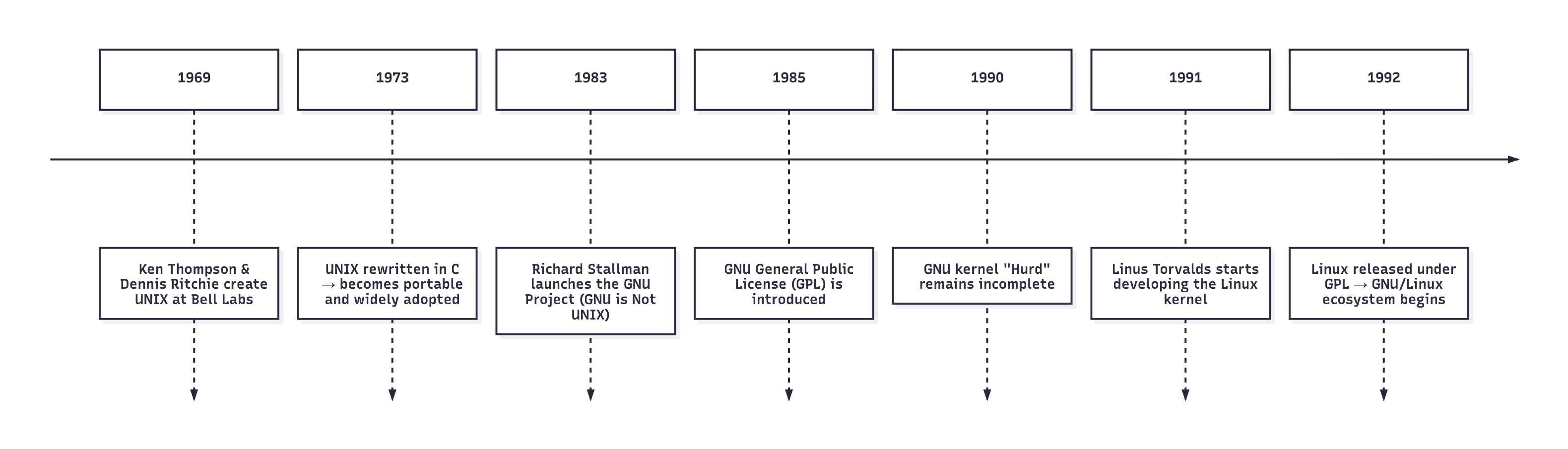
To understand how Linux was created, we must go back to 1969 when Ken Thompson and Dennis Ritchie of Bell Laboratories developed the UNIX operating system. It was later rewritten in the C programming language, which made it portable and led to its widespread adoption.
What was an important result of rewriting UNIX in C?
Over a decade later, Richard Stallman initiated the GNU project. GNU is a recursive acronym for "GNU's Not UNIX," and its goal was to create a completely free and open-source UNIX-like operating system. The project produced many essential components and the GNU General Public License (GPL), but its own kernel, the GNU Hurd, was not ready for general use when Linux became available.
Which major GNU component was not ready when Linux became available?
The Role of the Kernel
The kernel is the core component of an operating system. It acts as a bridge, allowing the hardware to communicate with the software. The kernel manages system resources, such as the CPU, memory, and peripheral devices. A complete operating system needs this resource-managing core in addition to the tools and applications people use.
Which responsibility belongs to the operating system kernel?
The Birth of the Linux Kernel
This brings us to 1991, when a Finnish student named Linus Torvalds began developing a new kernel as a personal project. This kernel became known as the Linux kernel. After Linux was released as free software in 1992, it could be combined with the nearly complete GNU system to form a complete free operating system, commonly called GNU/Linux. This milestone was a pivotal moment in the history of Linux.

Linus Torvalds in 2018 (Source: Wikipedia)
Who began developing the Linux kernel in 1991?
To continue your Linux journey, try these hands-on labs to practice fundamental commands and build your confidence in the command-line environment.
- Getting Started with Linux - Begin your Linux journey by learning essential terminal commands like
echo,date, and basic calculations. Perfect for complete beginners. - Your First Linux Lab - This introductory lab guides you through the classic "Hello, World!" program in Linux and teaches you some fundamental commands.
- Create Personalized Terminal Greeting - A quick and fun challenge to use basic Linux terminal commands to create an engaging welcome message.
Lesson complete
You finished Linux History
You can now explain how UNIX, GNU, and the Linux kernel contributed to modern Linux systems.
Describe why UNIX portability mattered.
Identify the kernel as GNU's major missing component.
Explain the kernel's role in managing system resources.
Identify Linus Torvalds as the creator of the Linux kernel.
Keep your learning progress
Create a free account to save this lesson and continue learning on any device.
Create a free account