简介
作为 Python 程序员,你可能会遇到「ValueError: too many values to unpack」错误,这可能会让人感到困扰。本实验将引导你理解该错误、确定根本原因,并学习解决问题的实用方法。完成本实验后,你将能够更有把握地处理这一常见的 Python 问题。
理解 ValueError: Too Many Values to Unpack
在本步骤中,你将重现解包错误,并区分值数量不匹配与解包不可迭代对象这两种情况。
当你尝试将多个值赋给一个变量或一组变量,但变量数量与值的数量不匹配时,Python 通常会出现 ValueError: too many values to unpack 错误。通常,这是因为赋值语句左侧的变量数量与右侧的值数量不一致。
Python 中的解包是什么?
Python 中的解包,是指在一条赋值语句中,将可迭代对象(例如列表、元组或字符串)的各个元素分别赋给多个变量。例如:
x, y, z = [1, 2, 3]
在这个例子中,值 1、2 和 3 会被解包,并分别赋给变量 x、y 和 z。
ValueError: too many values to unpack 的原因
以下情况可能导致 ValueError: too many values to unpack 错误:
变量数量和值数量不相等:赋值语句左侧的变量数量与右侧的值数量不一致。
x, y = [1, 2, 3] ## This will cause a ValueError解包不可迭代对象:这也是一种相关的解包错误,但 Python 会抛出
TypeError,而不是ValueError。例如,整数不可迭代,因此不能被解包。x, y = 42 ## This will cause a TypeError解包包含更多元素的生成器或迭代器:当你尝试解包的生成器或迭代器包含的元素数量超过变量数量时。
x, y = (i for i in range(5)) ## This will cause a ValueError
下面创建一个 Python 文件,实际查看这些错误。
打开 WebIDE 终端。如果当前不在项目目录中,请先进入该目录:
cd ~/project
然后使用 WebIDE 编辑器创建名为 unpack_error.py 的 Python 文件。
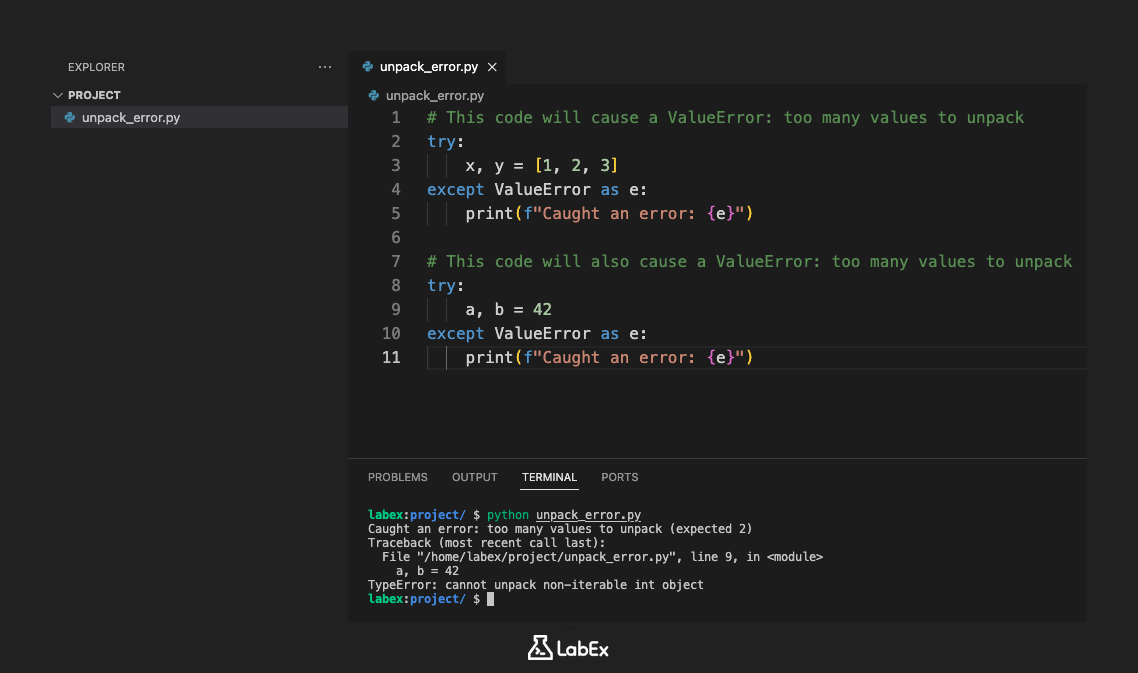
在 unpack_error.py 文件中添加以下代码:
## This code will cause a ValueError: too many values to unpack
try:
    x, y = [1, 2, 3]
except ValueError as e:
    print(f"Caught an error: {e}")

## This code will cause a TypeError because an integer is not iterable
try:
    a, b = 42
except TypeError as e:
    print(f"Caught an error: {e}")
保存文件。
现在,在终端中运行这个 Python 脚本:
python unpack_error.py
你应该会看到类似下面的输出,其中显示了 ValueError:
Caught an error: too many values to unpack (expected 2)
Caught an error: cannot unpack non-iterable int object
这展示了两种不同的解包失败情况。当可迭代对象提供的值多于变量能够接收的数量时,Python 会抛出 ValueError;当对象本身不可迭代时,Python 会抛出 TypeError。
识别和诊断错误
在本步骤中,你将通过检查赋值语句以及右侧的对象,诊断每一种解包失败情况。
遇到 ValueError: too many values to unpack 时,错误消息本身会提供有用的信息。它通常会告诉你代码期望接收的值数量,以及实际接收到的值数量。
例如,错误消息 ValueError: too many values to unpack (expected 2) 表示代码原本要将值解包到 2 个变量中,但实际接收到的值超过了 2 个。
你可以按照以下步骤诊断 ValueError: too many values to unpack 错误:
- 确定出错的代码行:回溯信息会指出发生错误的具体代码行。
- 检查赋值语句:查看该行的赋值语句,确定左侧的变量以及右侧的表达式。
- 确定变量数量:计算赋值语句左侧的变量数量。
- 检查右侧对象:确定该对象是否可迭代。不可迭代对象会导致
TypeError;可迭代对象在提供的值数量不正确时会导致ValueError。 - 比较数量:对于可迭代对象,比较变量数量与对象提供的值数量。
下面修改 unpack_error.py 文件,添加用于说明预期值和实际值的注释。
在 WebIDE 编辑器中打开 unpack_error.py。
将代码修改为包含以下注释:
## This code will cause a ValueError: too many values to unpack
## Expected variables: 2 (x, y)
## Actual values from [1, 2, 3]: 3
try:
    x, y = [1, 2, 3]
except ValueError as e:
    print(f"Caught an error: {e}")

## This code will cause a TypeError because an integer is not iterable
## Expected variables: 2 (a, b)
## The integer 42 supplies no iterable values
try:
    a, b = 42
except TypeError as e:
    print(f"Caught an error: {e}")

## Example of unpacking a generator with too many values
## Expected variables: 2 (c, d)
## Actual values from (i for i in range(5)): 5
try:
    c, d = (i for i in range(5))
except ValueError as e:
    print(f"Caught an error: {e}")
保存文件。
再次运行脚本:
python unpack_error.py
输出会与之前类似,但现在代码中的注释会明确写出预期数量和实际数量,帮助你理解错误发生的原因。
Caught an error: too many values to unpack (expected 2)
Caught an error: cannot unpack non-iterable int object
Caught an error: too many values to unpack (expected 2)
先检查右侧对象是否可迭代,再比较它提供的值数量与变量数量,就可以区分 TypeError 和 ValueError: too many values to unpack。
解决 ValueError:实用方法
在本步骤中,你将通过匹配变量数量和可迭代对象中的值数量来解决 ValueError。
现在你已经了解了 ValueError: too many values to unpack 的原因和诊断方法,下面学习几种解决这一问题的实用方法。
方法 1:调整变量数量
最直接的方法是调整赋值语句左侧的变量数量,使其与右侧的值数量一致。
使用 WebIDE 编辑器,在 ~/project 目录中创建名为 unpack_solution1.py 的新 Python 文件。
将以下代码添加到 unpack_solution1.py:
## Example 1: Adjusting variables to match a list
data1 = [10, 20, 30]
## We have 3 values, so we need 3 variables
x, y, z = data1
print(f"Example 1: x={x}, y={y}, z={z}")

## Example 2: Adjusting variables to match a tuple
data2 = ('apple', 'banana')
## We have 2 values, so we need 2 variables
fruit1, fruit2 = data2
print(f"Example 2: fruit1={fruit1}, fruit2={fruit2}")

## Example 3: Adjusting variables to match a string (unpacking characters)
data3 = "hi"
## We have 2 characters, so we need 2 variables
char1, char2 = data3
print(f"Example 3: char1={char1}, char2={char2}")
保存文件。
在终端中运行脚本:
python unpack_solution1.py
你应该会看到以下输出:
Example 1: x=10, y=20, z=30
Example 2: fruit1=apple, fruit2=banana
Example 3: char1=h, char2=i
在这些示例中,左侧的变量数量与右侧可迭代对象中的元素数量完全一致,因此避免了 ValueError。
解决 ValueError:使用星号运算符
在本步骤中,你将使用星号(*)运算符,将可迭代对象中多余的值收集到一个列表中。
有时,你可能只想解包可迭代对象的前几个元素,并将剩余元素收集到一个列表中。星号(*)运算符也称为「星号运算符」或「解包运算符」,非常适合这种情况。它可以将可迭代对象的剩余元素作为列表赋给一个变量。
使用 WebIDE 编辑器,在 ~/project 目录中创建名为 unpack_solution2.py 的新 Python 文件。
将以下代码添加到 unpack_solution2.py:
## Example 1: Unpacking the first element and collecting the rest
data1 = [10, 20, 30, 40, 50]
## Assign the first element to 'first' and the rest to 'rest_of_data'
first, *rest_of_data = data1
print(f"Example 1: first={first}, rest_of_data={rest_of_data}")

## Example 2: Unpacking the first two elements and collecting the rest
data2 = ('a', 'b', 'c', 'd')
## Assign the first two elements to 'item1' and 'item2', and the rest to 'remaining_items'
item1, item2, *remaining_items = data2
print(f"Example 2: item1={item1}, item2={item2}, remaining_items={remaining_items}")

## Example 3: Unpacking the last element and collecting the rest
data3 = [1, 2, 3, 4, 5]
## Assign the last element to 'last' and the rest to 'all_but_last'
*all_but_last, last = data3
print(f"Example 3: all_but_last={all_but_last}, last={last}")

## Example 4: Unpacking the first and last elements and collecting the middle
data4 = "python"
## Assign the first char to 'start', the last to 'end', and the middle to 'middle'
start, *middle, end = data4
print(f"Example 4: start={start}, middle={middle}, end={end}")
保存文件。
在终端中运行脚本:
python unpack_solution2.py
你应该会看到以下输出:
Example 1: first=10, rest_of_data=[20, 30, 40, 50]
Example 2: item1=a, item2=b, remaining_items=['c', 'd']
Example 3: all_but_last=[1, 2, 3, 4], last=5
Example 4: start=p, middle=['y', 't', 'h', 'o'], end=n
当可迭代对象中的元素数量可能超过显式命名的变量数量时,星号运算符可以灵活处理解包。添加 * 前缀的变量始终会接收剩余元素组成的列表;如果没有剩余元素,该列表也可能为空。
解决 ValueError:使用索引或切片
在本步骤中,你将使用索引和切片选择所需的值,而不是解包整个可迭代对象。
如果你只需要可迭代对象中的特定元素,不想解包全部元素,可以使用索引或切片访问所需内容。这样可以避免解包错误,因为你没有尝试在一条赋值语句中,将多个值赋给固定数量的变量。
使用 WebIDE 编辑器,在 ~/project 目录中创建名为 unpack_solution3.py 的新 Python 文件。
将以下代码添加到 unpack_solution3.py:
## Example 1: Using indexing to get specific elements
data1 = [100, 200, 300, 400]
## Get the first and third elements using indexing
first_element = data1[0]
third_element = data1[2]
print(f"Example 1: first_element={first_element}, third_element={third_element}")

## Example 2: Using slicing to get a subset of elements
data2 = ('a', 'b', 'c', 'd', 'e')
## Get elements from index 1 up to (but not including) index 4
subset_of_data = data2[1:4]
print(f"Example 2: subset_of_data={subset_of_data}")

## Example 3: Using indexing with a string
data3 = "hello"
## Get the second character
second_char = data3[1]
print(f"Example 3: second_char={second_char}")
保存文件。
在终端中运行脚本:
python unpack_solution3.py
你应该会看到以下输出:
Example 1: first_element=100, third_element=300
Example 2: subset_of_data=('b', 'c', 'd')
Example 3: second_char=e
使用索引([])和切片([:]),可以访问可迭代对象中的单个元素或部分元素,而不需要让变量数量与元素总数匹配。当你不需要解包全部内容时,这是处理可迭代对象的一种常见且安全的方法。
总结
在本次全面的 Python 教程中,我们学习了「ValueError: too many values to unpack」错误。你了解到,当赋值左侧的变量数量与右侧可迭代对象中的元素数量不匹配时,就会出现此错误。
你练习了:
- 识别错误并理解其原因。
- 通过比较变量数量和值数量来诊断错误。
- 通过调整变量数量来解决错误。
- 使用星号(
*)运算符进行灵活解包。 - 使用索引和切片访问特定元素,而不进行完整解包。
通过理解底层原理并应用本实验介绍的实用方法,你现在已经能够处理这一常见错误,并提升 Python 编程技能。掌握错误处理是成为熟练 Python 开发者的重要一环。