Introduction
In this project, you will learn how to change the default error log location for the MySQL database server. By the end of this project, you will be able to:
- Create a dedicated directory for storing MySQL error logs
- Set the appropriate permissions and ownership for the log directory and file
- Modify the MySQL configuration files to change the default error log location
👀 Preview

🎯 Tasks
In this project, you will learn:
- How to create a new directory for storing MySQL error logs
- How to change the user, group, and permissions for the log directory and file
- How to modify the MySQL configuration files to set the new error log location
🏆 Achievements
After completing this project, you will be able to:
- Customize the location of the MySQL error logs to a more convenient directory
- Ensure proper permissions and ownership for the MySQL error log files
- Confidently navigate and modify MySQL configuration files to suit your needs
Create the MySQL Log Directory and Set Permissions
In this step, you will create the MySQL log directory and set the appropriate permissions.
Create the
mysqldirectory under the~/projectdirectory and move themy.logfile into this directory.mkdir ~/project/mysql touch ~/project/mysql/my.logChange the user, user group, and mode of the
~/project/mysql/my.logfile and the~/project/mysqldirectory using thesudocommand.sudo chown mysql:mysql ~/project/mysql/my.log sudo chown mysql:mysql ~/project/mysql sudo chmod 755 /home/labex
This command sets the owner and group of the my.log file and the mysql directory to mysql:mysql, and sets the permissions on the home directory (/home/labex) to 755 (read, write, and execute for the owner, read and execute for the group and others).
Modify the MySQL Configuration Files
In this step, you will modify the MySQL configuration files to change the default error log location.
Navigate to the
/etc/mysql/mariadb.conf.ddirectory.cd /etc/mysql/mariadb.conf.dOpen the
50-server.cnffile using a text editor.sudo vim 50-server.cnfIn the
[mysqld]section, uncomment thelog_erroroption and set the path to"/home/labex/project/mysql/my.log".[mysqld] log_error = /home/labex/project/mysql/my.log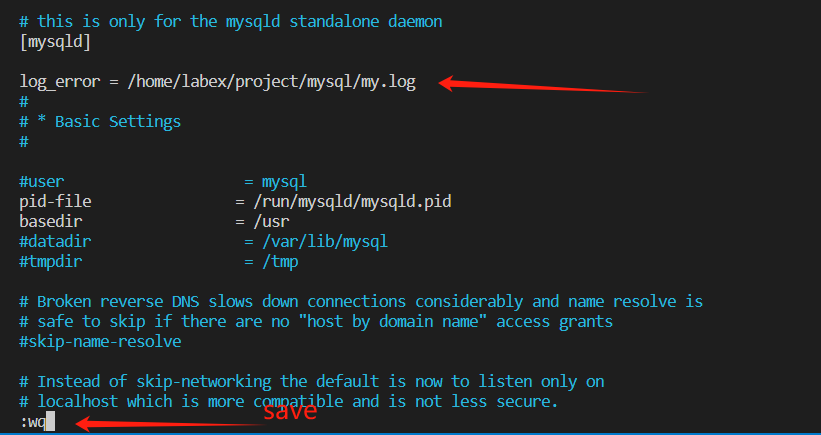
Open the
50-mysqld_safe.cnffile using a text editor.sudo vim 50-mysqld_safe.cnfIn the
[mysqld_safe]section, comment out theskip_log_erroroption.[mysqld_safe] #skip_log_error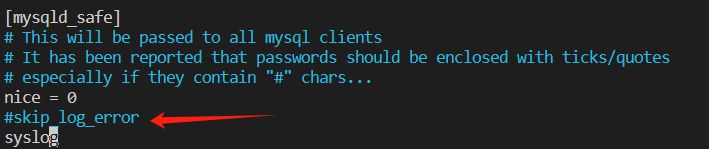
These changes will ensure that the MySQL error logs are written to the my.log file in the ~/project/mysql directory, and that the skip_log_error option is commented out.
Restart the MySQL Service and Verify the Changes
In this step, you will restart the MySQL service and verify that the changes have been applied correctly.
Start the MySQL service.
sudo service mysql startConnect to the MySQL command-line interface.
mysql -urootUse the SQL statement to check the value of the
log_errorvariable.SHOW VARIABLES LIKE 'log_error';MariaDB [(none)]> SHOW VARIABLES LIKE 'log_error'; +---------------+----------------------------------+ | Variable_name | Value | +---------------+----------------------------------+ | log_error | /home/labex/project/mysql/my.log | +---------------+----------------------------------+ 1 row in set (0.001 sec)
The output should show that the log_error variable is set to the correct path, /home/labex/project/mysql/my.log.
Congratulations! You have successfully changed the MySQL error log location to the my.log file in the ~/project/mysql directory.
Summary
Congratulations! You have completed this project. You can practice more labs in LabEx to improve your skills.